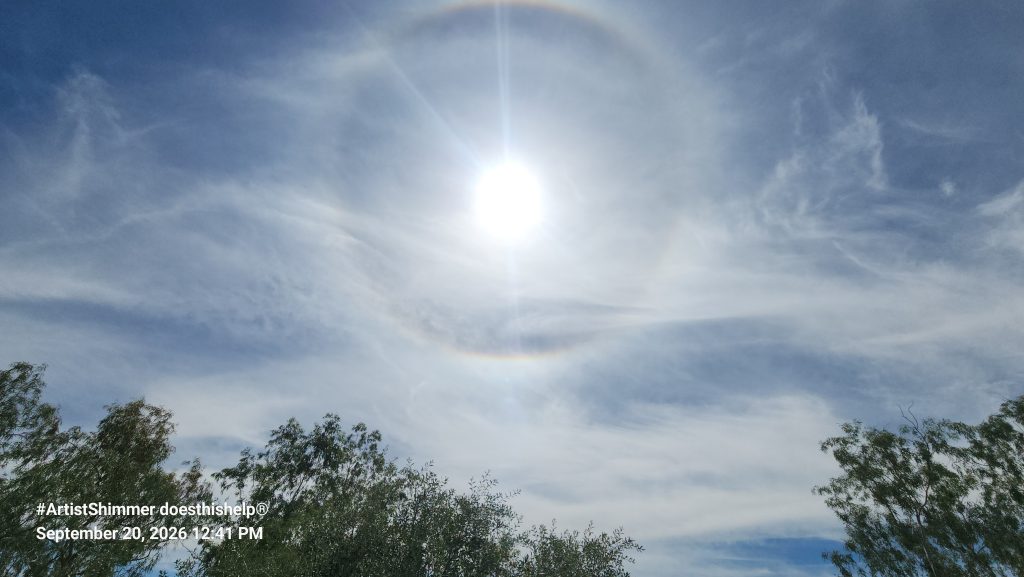
DOES THIS HELP® 🌞 Why Is There a Ring Around the Sun?
Photographed September 20, 2026 at 12:41 PM
Photo: #ArtistShimmer — DoesThisHelp®
Look carefully at the photograph.
There is a huge circle around the Sun.
The Sun did not suddenly grow a ring. There isn’t a physical circle floating around it either.
What you’re seeing is something happening between the Sun, Earth’s atmosphere, and your eyes.
The phenomenon is called a solar halo.
Step 1 — Start with what we KNOW
Science begins with observation.
From the photograph we can observe:
- The Sun is extremely bright.
- Thin clouds are covering part of the sky.
- A large circular halo appears centered on the Sun.
- Parts of the halo contain faint colors.
- There is also a small blue-green spot below the Sun.
That last observation is important because not everything appearing in a photograph necessarily existed in the sky. The little blue-green spot is consistent with camera lens flare caused by photographing such a bright light source.
The large circle, however, is an atmospheric optical phenomenon.
Step 2 — There is ice above us
Even on a very hot Arizona day, the atmosphere thousands of feet above Earth can be extremely cold.
High clouds such as cirrus and cirrostratus clouds can therefore contain tiny crystals of ice.
Many of these crystals have a six-sided, or hexagonal, structure.
Think of each crystal as an incredibly tiny prism.
Now imagine millions of those little prisms floating through the sky.
Step 3 — Sunlight enters the ice
Sunlight travels through space and enters Earth’s atmosphere.
When a ray of sunlight passes from air into an ice crystal, its speed changes slightly and its direction changes.
Scientists call this:
REFRACTION
You can see refraction yourself.
Put a straw into a clear glass of water.
The straw can appear bent where it enters the water.
The straw isn’t actually bent.
The light changed direction.
The same physical principle operates when sunlight passes through an ice crystal.
Step 4 — Why does it make a circle?
Here’s the really cool part.
For the common solar halo in your photograph, a great deal of the light reaching the observer has been deflected by approximately:
22°
That’s why this phenomenon is called a 22-degree halo.
Imagine drawing an invisible line from your eye directly to the Sun.
Now measure approximately 22 degrees away from that line in every possible direction.
Up.
Down.
Left.
Right.
And everywhere between.
Those positions together form a circle.
⭕ That’s the halo.
The circle isn’t actually sitting in one particular location in the atmosphere.
It is an optical geometry created between the Sun, ice crystals, and the observer.
Step 5 — Why are there colors?
White sunlight contains many wavelengths of visible light.
When sunlight passes through ice, different wavelengths are refracted by slightly different amounts.
That process is called:
DISPERSION
It’s related to the physics that produces colors through a glass prism.
So the sequence is:
SUN ☀️ → WHITE LIGHT → ICE CRYSTAL 🧊 → REFRACTION → SEPARATED COLORS 🌈 → YOUR EYES 👀
That is why parts of a solar halo can have reddish, orange, yellowish, or bluish coloration.
Step 6 — Here’s an important scientific idea
Suppose Tyler stood next to Mom when this photograph was taken.
Both could see the halo.
But suppose somebody was standing several miles away.
They might see a solar halo too.
They would not be receiving their halo light through exactly the same individual ice crystals.
Their eyes occupy a different position.
Different crystals would therefore have the correct geometry to send sunlight toward their eyes.
That teaches us something fascinating:
The halo depends partly upon the observer.
That doesn’t mean the halo is imaginary.
The Sun is real.
The ice crystals are real.
The light is real.
The refraction is real.
But the particular circle you perceive depends upon the geometrical relationship among those things and your location as the observer.
That distinction is important throughout science.
🧠 Tyler’s Vocabulary
Observation: Something we detect or measure.
Atmosphere: The gases surrounding Earth.
Ice crystal: Frozen water arranged into an ordered molecular structure.
Hexagonal: Having six sides or a sixfold structure.
Refraction: The bending of light when it passes from one material into another.
Dispersion: Different wavelengths of light being refracted by different amounts.
Optics: The scientific study of light and how it behaves.
Solar halo: An optical phenomenon produced when sunlight interacts with ice crystals in Earth’s atmosphere.
22° halo: The common circular solar halo appearing approximately 22 degrees from the Sun.
Lens flare: Light reflected or scattered inside a camera’s optical system, producing something in a photograph that wasn’t actually located in the photographed scene.
🔬 Try an experiment
Hold your arm straight out and spread your hand wide.
For many people, the distance from the tip of the thumb to the tip of the little finger at arm’s length is roughly 20–25 degrees.
Don’t look directly at the Sun.
Instead, when another halo appears, safely block the Sun behind a building, pole, tree, or other object and estimate the distance from the hidden Sun to the halo.
You’ll discover that its apparent radius is roughly one hand-span.
That’s approximately the famous 22 degrees.
The bigger lesson
Science doesn’t require us to choose between wonder and explanation.
You can look at this photograph and say:
“Wow. That’s beautiful.”
Then science lets you ask:
“How did that happen?”
We observe.
We ask questions.
We test explanations.
We measure.
We compare what we observe with what physics predicts.
And sometimes the explanation makes what we saw even more remarkable.
☀️ Sunlight + 🧊 ice + 📐 geometry = 🌈 a solar halo
Tyler’s question for today:
If the Sun stayed exactly where it was but all of the ice crystals disappeared, what would happen to the halo—and why?